In Little Phil: A reassessment of the Civil War Leadership of Gen. Philip H. Sheridan, historian Eric J. Wittenberg critically examines the military performances of the famous Union commander.
Jeb Smith considers this.
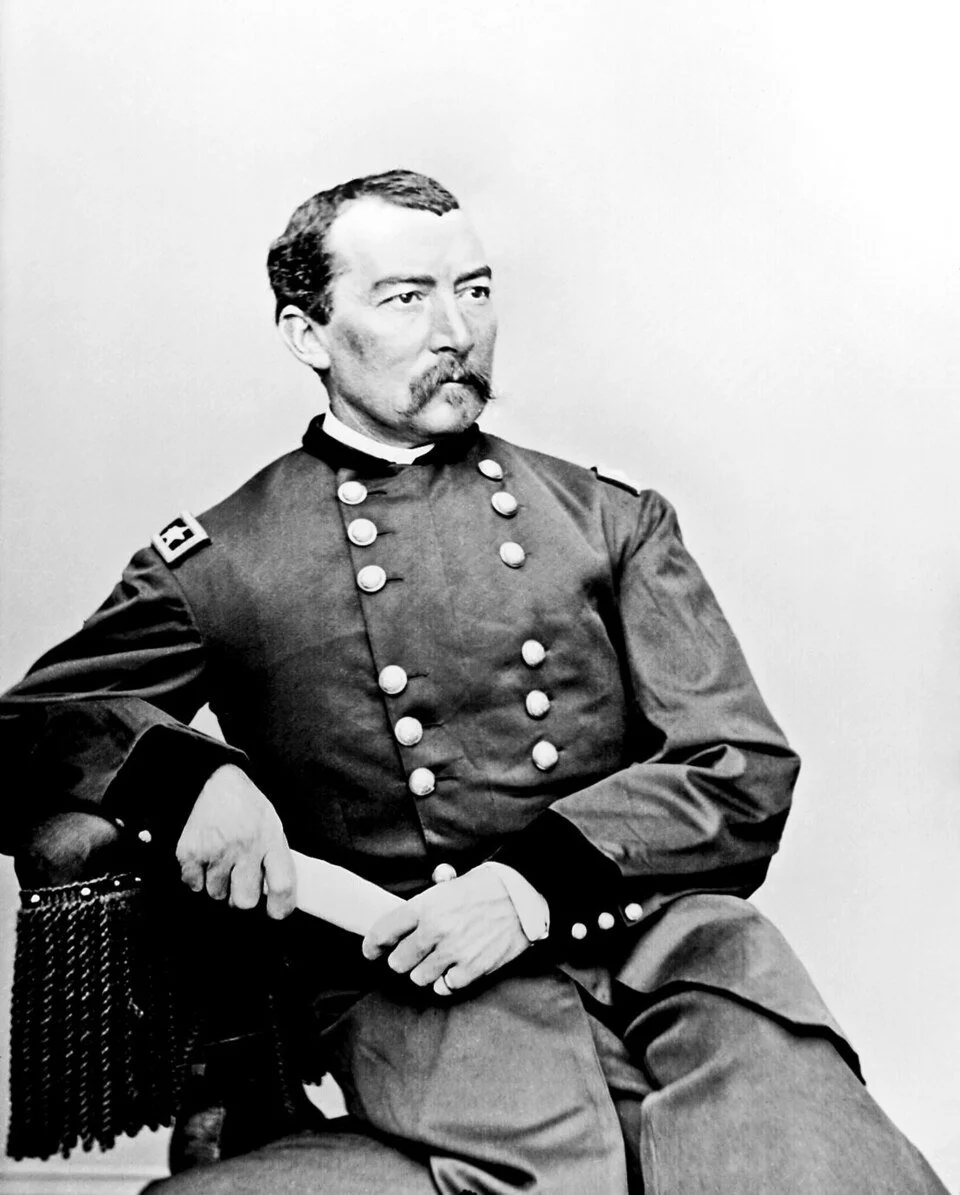
General Philip H. Sheridan. Source: Public domain. unknown, available here.

Wittenberg argues that the military record, and our memory of “Lil Phil,” has been distorted to his advantage, in no small part because Sheridan, and the North’s two most famous and admired generals from the conflict, William T. Sherman and two-time president U.S. Grant, all wrote popular autobiographies after the war. Further, Sheridan became an “American hero” in the federal government’s war against the Indians after the Civil War, further inflating his reputation as a Civil War commander.
Remembered as a great cavalry general, Wittenberg focuses especially on this aspect of Sheridan’s legacy. A well-suited historian to do so , he has delved as deeply as any into the largest cavalry battle of the war, which occurred in 1864 at Trevilian Station. Having been told it was a major victory for Sheridan, he came to find from the official documents that it was, in fact, a major Union defeat. Originally an admirer of Sheridan as a commander, he writes that, not only at Trevilian Station but in many of his engagements, “I was disappointed to learn that the official record does not match Sheridan’s legacy.” Around the same time, he edited a book that examined many of Sheridan’s actions, especially those around Appomattox, which forced an overhaul of the author’s opinion of Sheridan as a general. He wrote “I concluded that Sheridan does not deserve the lofty reputation bestowed upon him by history.”
While Wittenberg covers Sheridan’s performances in the west, both positive and negative, Little Phil focuses primarily on the General as a cavalry and corps commander of the Army of the Potomac in 1864, Wittenberg arguing that before this time he was a subordinate and did not have much influence on battles one way or the other. He casts Sheridan as an awful, harsh leader to his subordinates, who was unable to admit his own poor performance; many viewed him as petty, self-promoting, and hypocritical.
Wittenberg argues that the Union cavalry had already “turned a corner” in mid to late 1863, many by then equipped with breechloaders, Spencer rifles, and that by the time Sheridan came east he had well-armed veterans under him, while most Confederates were still ill-equipped to face the massive technological advantages of the Northern cavalry. The newly-created Cavalry Bureau also provided a supply advantage to the Northern forces. So, when the 1864 campaign began, the North had a massive numerical and technological advantage, almost unprecedented in the history of warfare—over 10,000 well-trained, well-equipped, well-supplied mounted troopers at Sheridan’s command.
At the Battle of the Wilderness, Sheridan, with Wilson’s division, was overaggressive, leading to heavy losses against the “Laurel Brigade” and preventing him from warning Meade of the Army of Northern Virginia’s position, thereby allowing the Southern cavalry to gain a strategic edge. Sheridan’s cavalry then failed to move on Lee’s flank and was halted by skirmishing along the Plank Road from May 5-8. Grant attempted to maneuver on Lee’s flank, but was thwarted because Sheridan failed to clear the road of Confederates between the Wilderness and Spotsylvania Court House. Sheridan’s failure to beat Lee’s cavalry to the Spotsylvania county seat so angered General Meade that personal animosity arose between them that never subsided.
On May 9 Sheridan’s command set out with the goal of killing famed Confederate cavalry general Jeb Stuart, he stating “there isn’t cavalry enough in the Southern Confederacy to stop us.” The battle commenced at Yellow Tavern, where the chivalrous Stuart refused to submit and attacked with only half his force, eventually being repulsed and killed in action. With over twice the force, well-supplied and equipped with an advantage in artillery and firearms, Sheridan was victorious.
After the death of Stuart, Lee reorganized his cavalry into three divisions that reported directly to him. Like Jackson, Lee was feeling the ill effects and burden of losing competent corps-level commanders. Southern cavalry was no longer what it had been without Stuart; William L. Wilson of the 12th Virginia Cavalry stated, “The cavalry corps has lost its great leader, the unequalled Stuart. We miss him much. Hampton is a good officer but Stuart’s equal does not exist.” The North took Stuart’s death as a great victory in itself.
On May 28, the Battle of Haw’s Shop ended in a stalemate. However, the outnumbered Wade Hampton managed to defeat Sheridan on June 11 and 12 at Trevilian Station, engaging in two days of fighting and inflicting twice as many losses on the Federal forces as he sustained. A final Southern assault on the center and flank broke the Union lines, driving them from the field. Sheridan failed to achieve any of the raid’s objectives, particularly in disrupting vital rail junctions.
As Sheridan retreated, Hampton’s smaller army continued to pursue him, attempting to engage in battle. However, Sheridan consistently refused to fight, aided by a river that separated the two forces. Hampton pursued and won at Samaria Church, successfully repelling Sheridan’s raid. Following this disaster, Sheridan was removed from cavalry command and sent to the Shenandoah Valley. Wittenberg summarized his actions as a cavalry general, stating that:
“Sheridan did poorly in command of the cavalry corps. During his four months of leadership, the corps conducted three major raids, and fought thirteen major engagements…only Yellow Tavern can be considered a victory for the Yankee horse soldiers…in several of these fights, the federals were lucky to get out intact. He certainly did not earn the respect of southern cavalry. Brig general Thomas L. Rosser said “Sheridan displayed no skill in maneuvering, it was simply a square stand up fight, man to man, and Hampton whipped him.”
He did not serve well as the eyes and ears of the main body, and failed in the ultimate objectives of all four raids Grant sent him on. His neglect of the main command led to the army being trapped and vulnerable at the various North Anna engagements. Luck saved the Yankee army in those instances. Wittenberg adds, “Sheridan employed unimaginative tactics. His cavalry often fought as infantry, and he rarely demonstrated a true understanding of the nature of mounted combat.” And “Sheridan was not a great cavalry commander. In fact his tenure as leader of the Army of the Potomac’s cavalry corps was lackluster at best.” And he quotes Thomas Rosser, who wrote “As an infantry officer, Sheridan possessed fair ability, as a cavalry officer, he was the most absolute failure.”
The Valley
When he began the Valley Campaign, Sheridan had a 2-1, and at times a 3-1, advantage in manpower. Yet he began very tentatively. His own subordinates carried out and planned most of the tactics used in battle; General Crook planned Fisher’s Hill, and the famous victory at Cedar Creek was already going the way of the North due to General Wright. Even Sheridan admitted to George Crook that the same result would have occurred whether he had arrived or not, as the battle had already begun to turn against the outnumbered Confederates. The entire time, he could not find a way to deal with the famous Confederate cavalryman John Mosby and his men, who wreaked havoc upon the Union army throughout the entire campaign. Wittenberg summarized:
“A detailed analysis of Sheridan’s record indicates that he lost most of the cavalry corps’ fights during his stewardship. It also shows that any competent general should have dispatched Lt. Gen. Jubal Early’s Confederate Army in the fall of 1864. Indeed, the odds were so overwhelming that even an incompetent commander should have defeated Early’s tenacious little army…Early actually out-generaled Sheridan at Winchester and Cedar Creek, two of their three major engagements.”
Jeb Smith is an author, speaker, and historian who has written five books, published over 130 articles in several publications, and has been featured on various podcasts, television, and radio interviews. For speaking engagements, interviews, or questions, please get in touch with him at authorJebSmith.com.
Enjoyed the piece?
Join thousands of history readers getting occasional updates on new blog posts, books, and video releases — plus a free history book to get you started.