On Wednesday, Microsoft introduced the Surface Laptop Ultra, the first laptop to ship with Nvidia’s new RTX Spark processor (there will be offerings from other companies like HP and Lenovo, too). At a glance, it seems pretty clear that they’re gunning for Apple.
Up to 20 ARM-based CPU cores and a big fat Nvidia Blackwell GPU with up to 6,144 cores (Nvidia and Apple count GPU cores very differently). A big bright HDR display, from 24GB to 128GB of RAM, and SSDs from 512GB to 2TB… this is Microsoft’s version of a MacBook Pro, all right. Even the price is somewhere in line with a 16-inch M5 Pro MacBook Pro: it starts at $2,599, but that’s for a version of the chip with fewer cores and will a 512GB SSD, half what you get in the base model of the 16-inch MacBook Pro.
These systems are being pitched at developers working with local AI models, some of which take tens of gigabytes of memory. During Microsoft’s presentation, models as big as 60GB were touted, and the 128GB unified memory maximum was hyped as a key benefit. That sounds very much like Apple’s MacBook Pro pitch these days.
Specs between the two systems are very hard to compare, as neither company really lists comparable features or performance figures. But let’s take the full-size RTX Spark laptop and stack it up next to the 16-inch MacBook Pro with M5 Max:
| M5 Max MacBook Pro | RTX Spark Surface Ultra | |
|---|---|---|
| Price as configured | $6,999 | $5,899 |
| CPU cores | 18 cores (6 super, 12 performance) | 20 cores (10 performance, 10 efficiency) |
| GPU cores | 40 cores | 6,144 cores |
| RAM | 128 GB (614 GB/sec) | 128 GB (300 GB/sec) |
| SSD | 2 TB | 1 TB |
You currently can’t get more than a 1TB SSD in the Surface Ultra if you choose the full-size processor with all the CPU and GPU cores. And you can’t get less than a 2TB drive from Apple in the 16-inch MacBook Pro with M5 Max with all its cores. But in other configurations, Microsoft charges $400 more for the 2TB SSD.
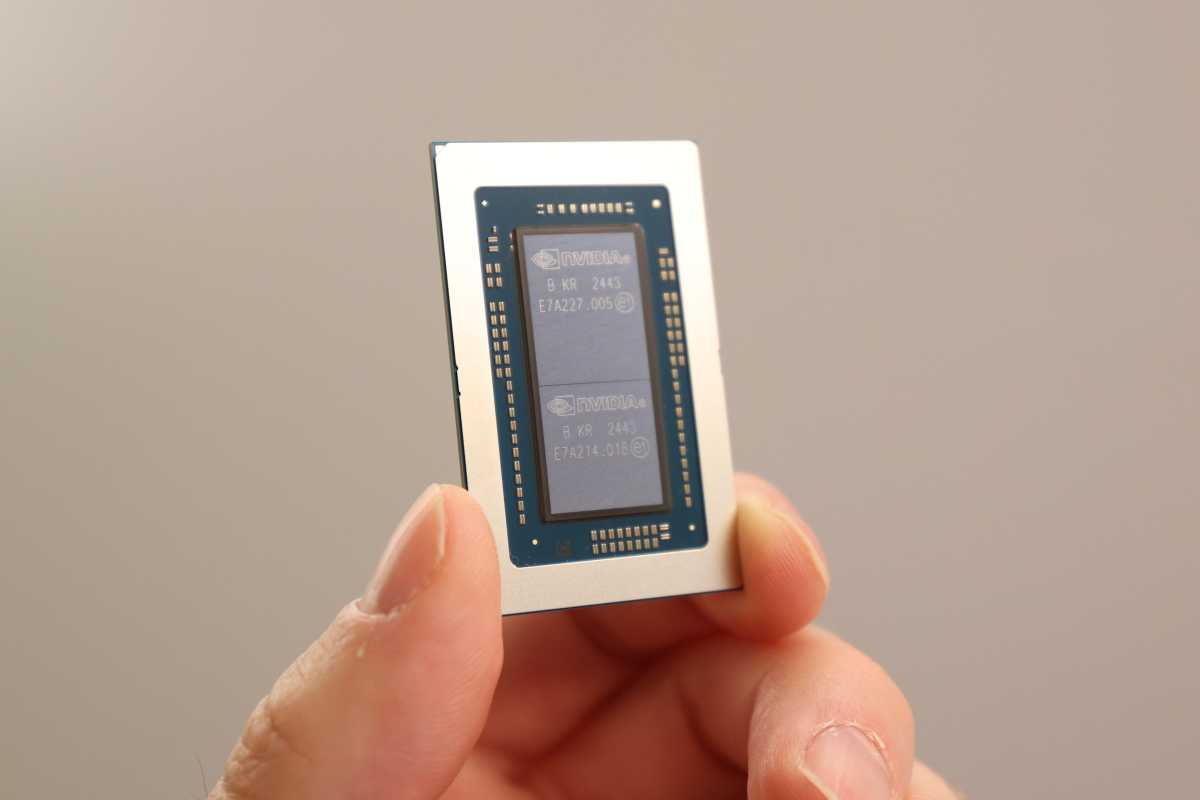
The chip specs are equally hard to compare, because the cores are different, and performance claims don’t use the same figures. But we can get some idea of relative CPU performance by looking at the benchmarks of the DGX Spark, which is a Linux-based desktop system that uses a version of the chip with identical specs as the RTX spark. The RTX Spark is basically the DGX Spark made for Windows 11 ARM laptops.
There’s a reason why Microsoft compared it to the M5 Pro. Apple’s M5 Max CPU absolutely crushes the DGX Spark CPU in Geekbench. Nvidia’s chip gets a single-core score of ~2,600 and multi-core score of ~23,700. Apple lands at ~3,700 single-core and ~35,600 multi-core. Yeah, 40-50 percent faster. I don’t think Apple has anything to worry about.
The GPU is where it gets more interesting. Both Apple and Nvidia have GPUs that are optimized for doing AI work, but they don’t list comparable specs. Nvidia claims 1 petaflop of FP4 performance, but you won’t find maximum performance specs using that format for Apple’s chip.
Adam Patrick Murray / Foundry
Nvidia claims about 100 teraflops of FP16 performance for the DGX Spark, so the RTX Spark should be similar. That figure for the M5 Max is about 70 teraflops. But Nvidia’s architecture is well-optimized for small, compact, quantized models using small data formats, and should handily beat Apple with those.
On the other hand, Apple’s M5 Max has more than twice the memory bandwidth. Depending on the model or data it accesses, memory bandwidth can quickly become the bottleneck. So for certain AI tasks, the M5 Max’s 614 GB/sec is going to give it a big advantage.
The Surface Ultra runs Windows 11 for ARM, which requires ARM-optimized applications to run at peak performance, and provides a sort of translation layer (called Prism) to run non-native apps. Right now, the vast majority of Windows apps are made for x86 processors and don’t have native ARM versions. That’s not really an issue for Apple, which is all but done with its ARM-based Apple Silicon transition. Nearly all Mac apps run natively on M-series processors, and Rosetta 2 is really only necessary for old software.
There are, of course, a lot of other considerations here. Microsoft’s laptop has a touchscreen, while the MacBook Pro does not (not yet, at least). Ports, battery life, charging speed, speakers and microphones, keyboard and trackpad quality, webcam quality… a laptop is so much more than its processor.
Apple has a big head start on AI software, too. Agentic AI research and deployment has been all over the Mac, since Apple has offered consumer-grade hardware with lots of unified, high-bandwidth memory for years. Researchers and businesses have been buying up Mac minis and Mac Studios with high memory pools as fast as they can to run big models locally. There’s a reason all the consumer “agent” AI apps, from Meta’s Muse or Claude Desktop start off on the Mac and come to Windows later.
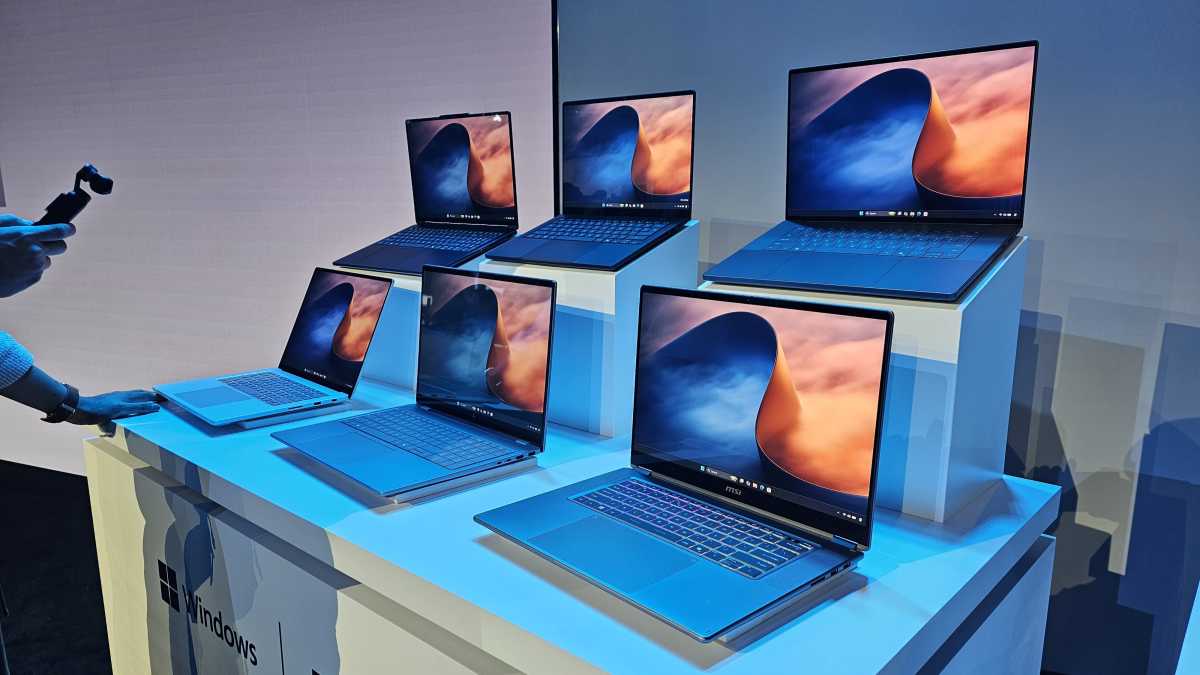
The Surface Ultra laptop has a nice processor and design, but it remains to be seen how it stacks up to the MacBook’s battery and build quality.
Mark Hachman / Foundry
Microsoft even just announced a new Windows framework for the local inferencing of AI models called “Windows ML” that supports models from PyTorch, TensorFlow/Keras, TFLite, scikit-learn, and others. That sounds exactly like the current function of the CoreML framework that Apple first introduced way back in 2017.
Ultimately, Apple doesn’t need to worry about the Surface Ultra or other RTX Spark laptops just yet. Those computers are all very expensive, and there’s no affordable option with the same architecture. Apple has Mac laptops from $1,299 that all use the same major processor architecture, operating system, APIs, and so on. At the end of the day, people buy Windows laptops (ARM-based or not) because they want to run Windows, and the buy Macs because they want to run macOS.
But RTX Spark laptops like the Surface Ultra do show that Apple was on the right track the whole time: A single energy-efficient processor with a lot of ARM cores, a powerful GPU, and a big pool of unified memory? That sounds exactly like what Apple has been delivering to customers for years.