Lillian Smith was a remarkable Southern white woman who fought to end segregation as early as the 1930s. She wrote multiple bestselling books which were censored, banned, and burned across the country. Unfortunately, many people have no idea who she is today. In the piece below, An Inconvenient Woman author and historian Kerri Leigh Smith reveals this important woman whose legacy deserves to be recognized and honored.
The first time I arrived on Old Screamer Mountain, Lillian Smith’s home for most of her sixty-eight years, it was early fall. The leaves had begun their slow but lovely descent into their final few weeks of life, illuminating the clear sky with a vibrancy seemingly unnatural during death. Amidst the brilliant oranges, reds, and golds, there were also maroons, mustards, and burnt siennas, reminding all who beheld their beauty how mournfully short life can be. I had been to Clayton before, many times, hiking the trails and admiring the Appalachians. But I had never been here. And it immediately felt serenely familiar. It felt like home.
As I would come to find in the months that followed, Lillian Smith and I had several things in common. Both born in other Deep South states (Smith in Florida, me in Mississippi), we would both eventually claim Georgia as home, despite bitterly disagreeing with most of the state’s white citizens. We both had childhoods burdened by troubling relationships with our mothers; we both had been profoundly educated by travel, especially abroad, during our teen and young adult years; we both had our lives’ work interrupted by serious illness and had to overcome several major losses; we both believed the key to dismantling racism involved a combination of personal relationships, education, art, psychology, and policy. We both began our speaking careers through civil rights organizations and colleges throughout the South and through various private organizations in New York; we both were impatient, morally rigorous (okay, perhaps righteous!), and admittedly, sometimes a bit too intolerant of intolerance. Finally, we both were far more progressive than most white Americans of our respective generations.
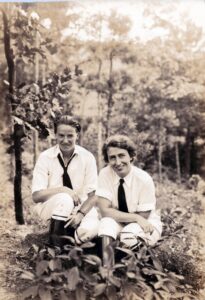
Intensely intrigued by the tiny, wire-framed woman from Old Screamer Mountain, I began researching in earnest. I was immediately enthralled: Lillian Smith was a white woman who fought to end segregation as early as the 1930s, a best-selling author whose books were censored, burned, and even banned in multiple cities across America, and a lesbian who lived with her lifelong partner Paula Snelling. It seemed clear that Smith had been nearly erased from history because she posed—and still poses—a threat to prevailing hierarchy and power structure.
But Lillian Smith, and her ideas, undoubtedly deserve to be known by every American. Her essays should be required reading in classrooms; entire college courses should be devoted to her written work and activism. As my interest in her turned into a book length project, I began working closely with Matthew Teutsch, the then-Director of the Lillian Smith Center (before it was defunded by Piedmont University). For years he worked tirelessly to restore Smith’s legacy, and on April 20, 2022, Lillian E. Smith finally received her own historical marker from the Georgia Historical Society.
“Smith openly challenged Jim Crow and provided a critical White voice on Southern race relations through her writings,” part of the marker reads, “including the novel Strange Fruit and memoir Killers of the Dream, and a literary magazine co-edited with her life partner Paula Snelling. Through her involvement with Civil Rights organizations, Smith became friends with Martin Luther King, Jr.”
By recognizing Paula as Lillian’s life and intellectual partner, it became one of—if not the only—historical markers in the Deep South to recognize a same-sex relationship. It is certainly one of the few markers in the entire state of Georgia honoring a woman. In a land awash with Civil War markers, the revolutionary nature of Lillian’s plaque cannot be overstated. One of the few women listed among thousands of men, and certainly one of the only LGBTQ+ people, she also remains one of the only white Southerners honored for their dedication to civil rights.
By the time the plaque was approved, I had given several speeches on the importance of Lillian Smith and her work, and had come to be known as an expert on her. Dr. Teutsch asked me to give the speech dedicating the historic marker. At that precise moment I knew I had to put other projects aside and finish writing An Inconvenient Woman, the first book dealing fully with Smith’s life, work, and even sexuality, in forty years.
My speech focused on Lillian Smith showing the sins of white America while simultaneously holding on to hope, lighting a path forward. She scolded and preached, but also welcomed back sinners with open arms and a forgiving heart. The key to peace, Smith argued, was creating new identities for white supremacists whose self-images had been shattered by modernity and progress: “when a man gives up something, even old defenses, he is not going to feel good unless he has something equal, or better, returned to him,” she wrote. “We must give our people new beliefs, new images of themselves to substitute for the old.”
New beliefs, new images of themselves: recipes to help heal society, even today. As I said in the dedication of the history marker, it is imperative to keep Lillian’s name and her important mission alive, to both guide and inspire us. Let her life remind us of the hard, often selfless, and sometimes dangerous work required to create an equitable, peaceful, and loving society. And let us all take up the mantle now, in honor and remembrance of Lillian Smith and all the other fearless freedom fighters.

The post Remembering Lillian Smith appeared first on The History Reader.